If your wedding date is flexible, October and November are a good place to start your Uttarakhand shortlist. March is also worth comparing for a lower-altitude celebration. For a summer wedding in the higher hills, look at April and May before treating June as an equally dry option.
Then ask a more useful question: will your guests be sitting outside at noon, or waiting for the pheras late at night? A month that suits one can feel quite different for the other.
These are planning recommendations based on the official climate records and destination information below. There is no single weather calendar for every Uttarakhand venue, and no month comes with a rain-free guarantee.
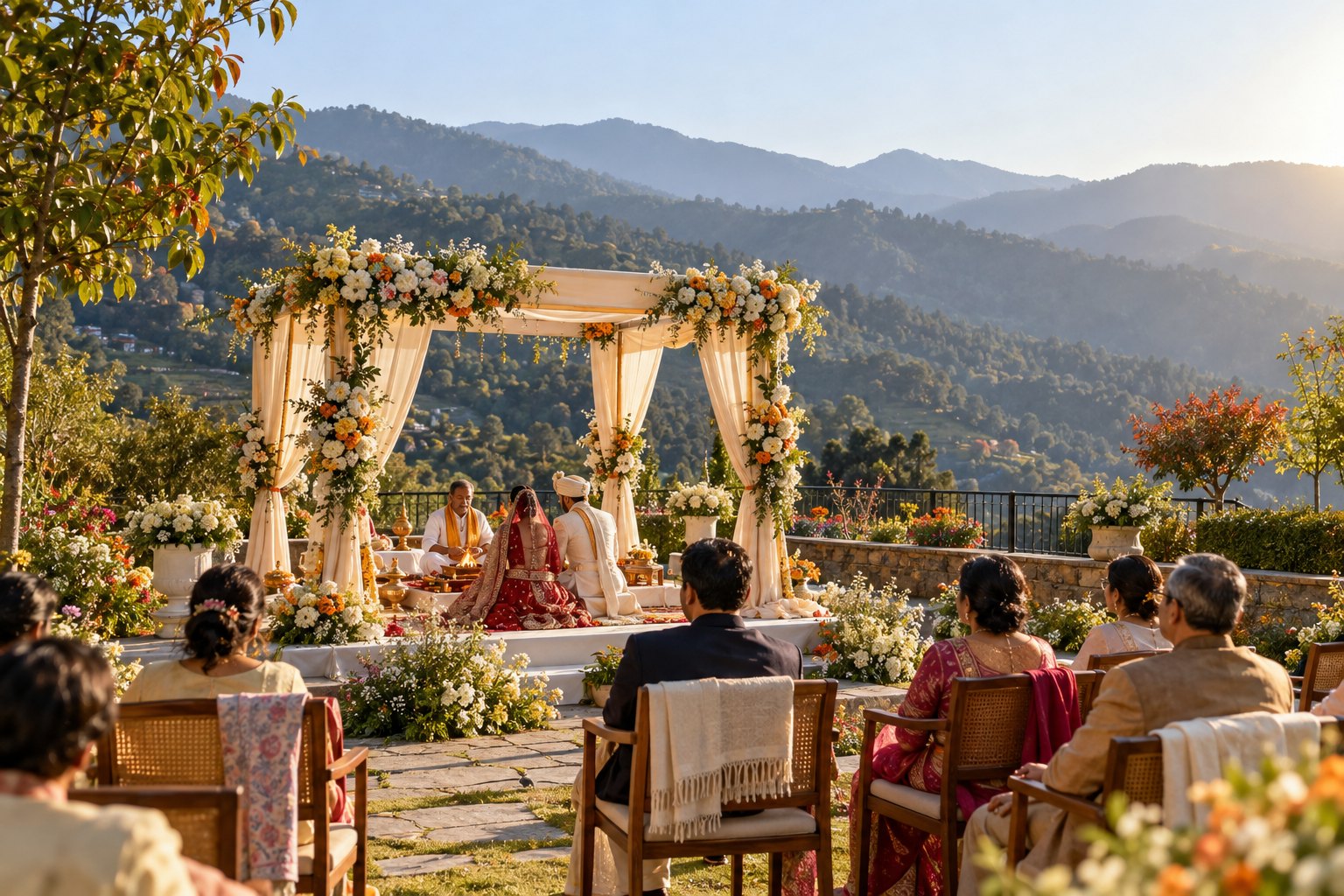
The short answer changes with the destination
Dehradun: compare October–November and March first if you want outdoor functions without choosing the hottest part of the year. December can work well for a daytime celebration, provided dinner and late ceremonies have a comfortable indoor option.
Mussoorie: April–May deserves a place beside October on your shortlist. Uttarakhand Tourism describes the town as sitting around 2,000 metres above sea level and highlights summer as a good time to visit. A hill venue’s evening arrangements still matter, even when the afternoon looks inviting. Source: Uttarakhand Tourism’s Mussoorie guide.
Rishikesh: begin by comparing October–November and March, then check the particular property rather than relying on the destination label. Rishikesh is a foothill destination; a river view does not make it a cool hill station. A hotel near the town and a resort higher up an approach road need separate weather and access checks. Source: Incredible India’s destination description.
For Mukteshwar and other higher hill locations, give extra weight to the evening temperature and the route your guests will travel. The Dehradun district administration explicitly notes that elevation creates substantial climate differences between the hills and the valley. Source: district climate information.
Uttarakhand wedding months: a practical date planner
Use this table to decide which months deserve a venue visit. The suggestions draw on the seasonal patterns in the Dehradun and Mukteshwar records; they are not forecasts for every town or resort.
| Month | How to approach the date |
|---|---|
| January | Choose the indoor evening space first. Use an outdoor ceremony as a daytime possibility, with a comfortable alternative ready. |
| February | Consider a daytime celebration, but keep cold evenings and possible rain in the plan. A higher hill venue needs particular care. |
| March | A useful first shortlist for Dehradun and lower-altitude venues. Check the evening setup separately at a hill property. |
| April | Compare valley and hill options carefully. In a warmer location, move a long outdoor lunch or ceremony away from the hottest hours. |
| May | Worth considering in the higher hills. For a valley wedding, prioritise shade, cooled indoor rooms and a shorter outdoor daytime programme. |
| June | Treat it as a transition month. Choose a venue where the wedding still works if outdoor functions move inside. |
| July | Plan the main celebration indoors from the outset. A lawn-only wedding is a poor match for the rainfall pattern. |
| August | Use the same indoor-first approach. Guest arrival and the route to the property matter as much as cover over the ceremony. |
| September | Keep a wet-weather plan. Do not book on the assumption that September behaves like October. |
| October | A strong starting point for an outdoor-led celebration. Retain an indoor alternative and plan for a cooler hill evening. |
| November | Low average rainfall in both records makes it attractive. Give dinner seating and late-night guest comfort more attention as temperatures fall. |
| December | Consider a daytime ceremony followed by an indoor evening. Do not make snowfall part of the wedding promise. |
Three weather details that can change your choice
1. September and October are not interchangeable
In IMD’s 1991–2020 Dehradun record, mean monthly rainfall is 305.9 mm in September and 38.3 mm in October. Mukteshwar shows the same broad change: 228.9 mm and 30.4 mm, respectively. These are two different stations, but neither supports casually grouping all of September with the drier autumn months. Dehradun data; Mukteshwar data.
If you love a venue’s lawn and would be disappointed to hold the wedding inside, this is a meaningful reason to compare October dates. If September is fixed, choose an indoor room you actually like. If you would never choose that room for your wedding, keep looking.
2. April means something different in the valley and the hills
The mean daily maximum for April is 32.5°C at Dehradun and 22.4°C at Mukteshwar in the same IMD baseline. That is why “Uttarakhand has pleasant summers” is too broad to plan a wedding around. Dehradun climate table; Mukteshwar climate table.
A long midday mehendi needs shade where people sit, not just above the stage. At a warmer property, an indoor lunch with a shorter outdoor gathering may be a better use of the day. At a hill venue, visit the actual event space at the hour you want to use it: sun, shade and exposure can change the experience within the same property.
3. A dry November can still mean a cold evening
November’s mean daily minimum is 11.4°C at Dehradun and 6.1°C at Mukteshwar. The minimum is not a prediction for your dinner hour, but it is a useful reminder to think beyond afternoon photographs. Dehradun climate table; Mukteshwar climate table.
If older relatives will be seated through a long ceremony, look at how easily they can move between the ceremony, dining room and bedrooms. A beautiful outdoor setting becomes less appealing if staying warm means missing half the evening. Discuss indoor seating and safe heating arrangements with the venue before fixing the programme.
How to read the figures: these are IMD’s 1991–2020 station averages. A mean daily maximum or minimum is not the full range of temperatures you may experience. Monthly rainfall is not the probability of rain on your wedding day. Mukteshwar’s figures are not Mussoorie’s, and Dehradun’s figures are not Rishikesh’s.
Can a monsoon wedding still make sense?
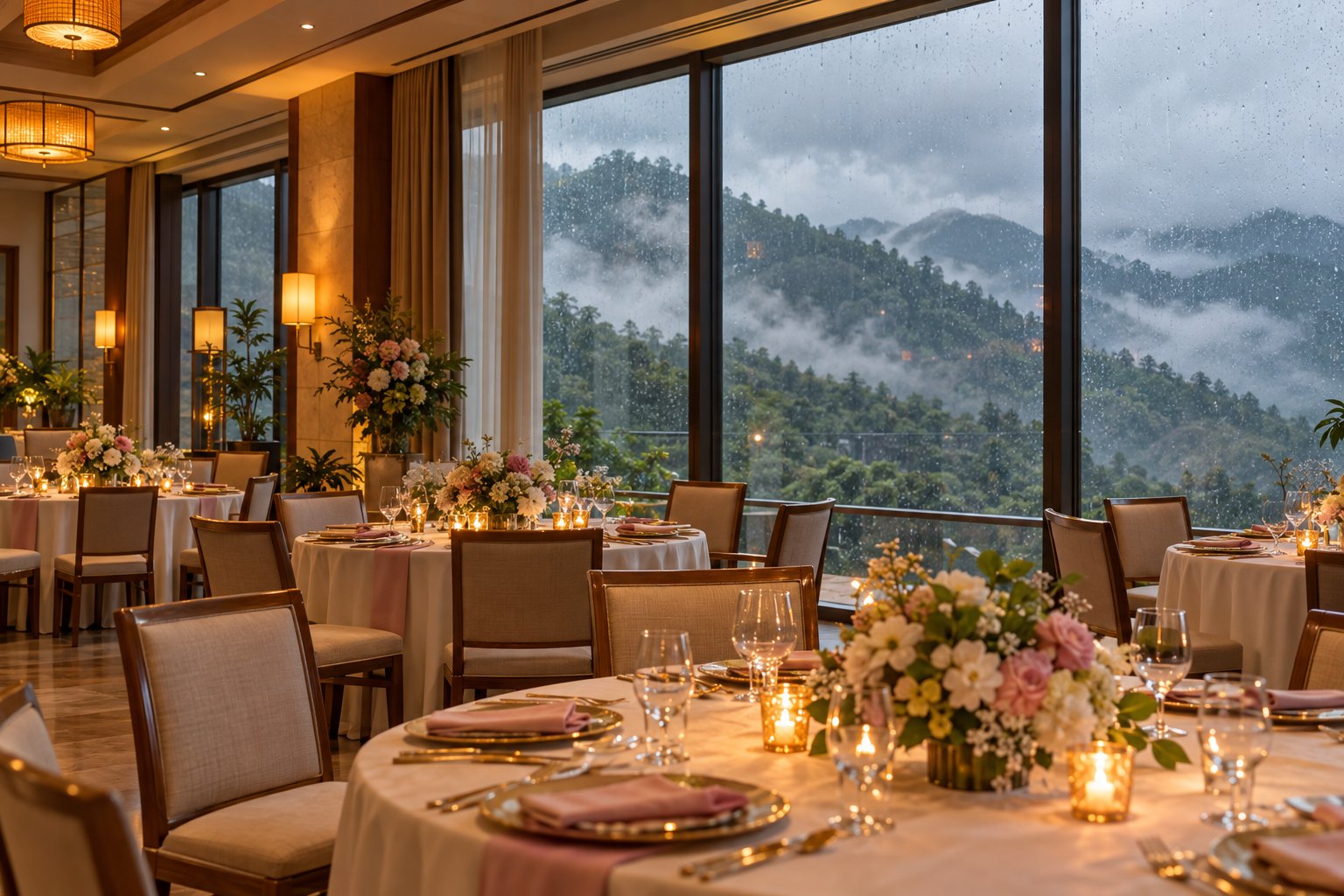
Yes, if the celebration you want works indoors and you accept that travel plans may need to change. It is a much weaker choice when the whole reason for booking is an uninterrupted outdoor ceremony or mountain-view dinner.
June already shows a marked rise in rainfall at both stations, with the wet season continuing through September. Dehradun district’s official climate description also identifies June–September as the main rainy period. Source: district climate information.
When comparing monsoon venues, ask to see the complete indoor wedding arrangement: guest seating, ceremony area, dining and movement between them. A room advertised for a standing reception may not accommodate the same number around dinner tables. The wedding venue capacity guide explains that distinction.
Also look beyond the event room. A covered ceremony does not solve an exposed walk from the bedrooms or a disrupted arrival route. If your date is fixed, those details should influence the venue choice before flowers and stage design do.
If your muhurat is fixed, change the programme before changing the whole wedding
A fixed date does not force every function into the same weather conditions.
For a winter wedding, you might keep portraits and a short family gathering outside, then move dinner and a late ceremony indoors. For a warmer-month wedding, you might hold lunch inside and leave the longer outdoor gathering for later. For a monsoon date, start with an indoor celebration and treat a usable outdoor window as a bonus.
The ceremony timing may be non-negotiable. The welcome meal, mehendi, photographs and guest downtime often offer more flexibility. Build the rest of the programme around the part you cannot move. Our two-night Uttarakhand wedding itinerary can help you work through that sequence.
Use climate to choose the month, then weather to run the event
Months ahead, compare the season, the venue’s exact location and the indoor plan. As the date approaches, switch to IMD’s local forecasts, district warnings and nowcasts. For travel conditions, check the Uttarakhand State Disaster Management Authority, which also links to the state road-status service.
Before guests travel, agree who checks those updates and who can change the arrival or event plan. A favourable long-term average must never outweigh a current warning or road closure.
Choose the month for the wedding you actually want to hold.
Tell BnB Weddings your preferred dates, destination and ceremony timings. We can help you turn those choices into a venue and celebration brief.
Sources checked on 16 October 2026. Climate averages guide the shortlist; check forecasts and local conditions for your dates.