A beautiful lawn is easy to picture on a venue visit. The harder question is what your wedding will look like if that lawn cannot be used. Where will everyone sit? When can the indoor room be prepared? And who can make the decision while you are getting ready?
For an Uttarakhand wedding, agree those answers before approving the outdoor design. A useful rain plan joins up the space, the people, the production schedule and the cost of changing course. It should be a version of the celebration you would be happy to host, not a room nobody has looked at properly.
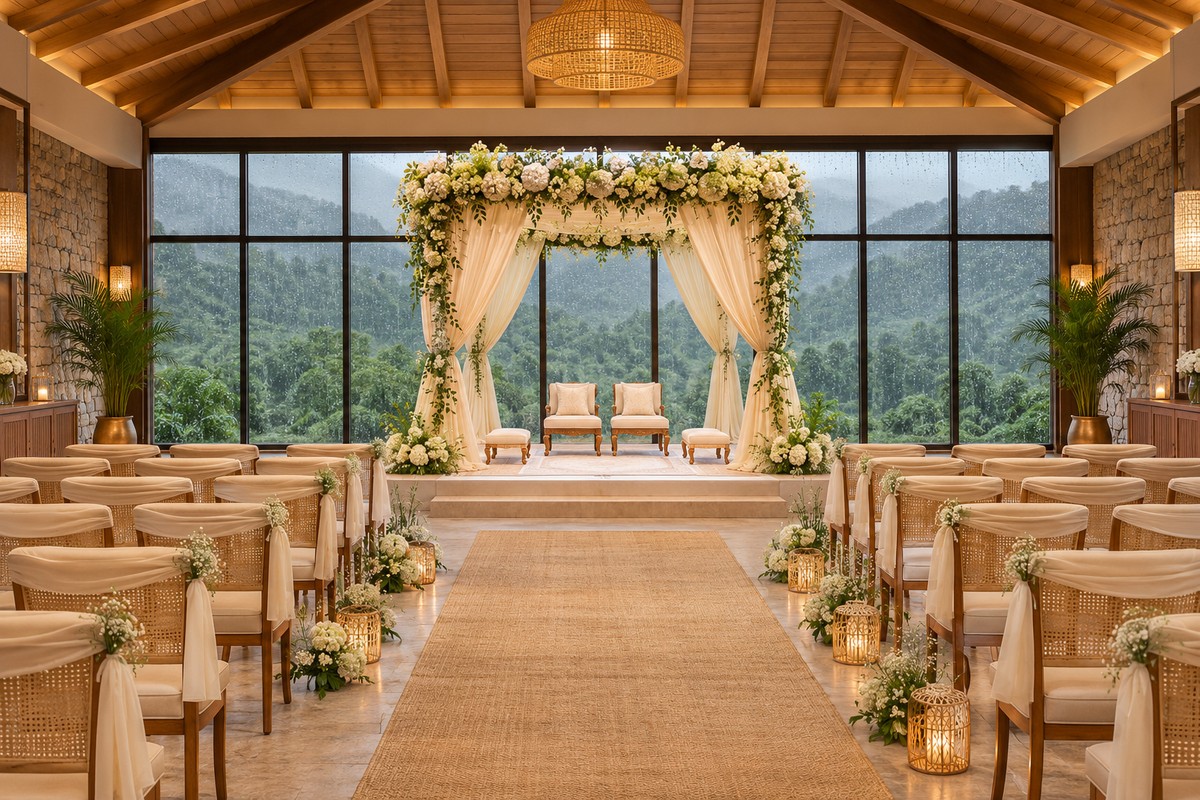
Reserve a specific alternative, not a reassuring phrase
Ask the venue to name the exact room offered as your alternative. Confirm the date, access hours, exclusive or shared use, setup conditions and any extra charge in your event agreement. Ask whether another booking could occupy it while your function is scheduled outdoors.
An indoor space appearing on a hotel's website does not establish that it is reserved for you. For example, Hyatt Regency Dehradun's official wedding page lists both the Regency Ballroom and outdoor lawns. That is useful when starting a conversation, but it does not confirm an automatic move between them or an available backup on your date.
Ask the team to show you the alternative with your intended setup: ceremony seating, mandap, technical equipment and the routes guests and staff need. A room's advertised capacity does not settle all of those details. Use our wedding venue floor-plan guide for the wider capacity questions, then sign off the particular indoor arrangement you would use.
Give each function its own answer
A suitable ceremony room may not be suitable for dinner at the same time. If you want both functions indoors, establish whether they use separate spaces or require a reset. A reset needs a place for guests to wait and a team-confirmed allowance for clearing, setting, checking and reopening the room.
Walk through haldi, mehendi, ceremony and dinner separately. For a small mehendi gathering, comfortable seats and good working light may be central. For dinner, the catering route, queues, seating and service arrangements all need to work. Ask the venue and relevant suppliers about restrictions on materials, equipment and activities before assuming an indoor substitution is possible.
If your ceremony includes a sacred fire, discuss the indoor arrangements with the officiant and venue in advance. Do not assume an outdoor permission carries indoors. The venue's designated team must confirm the applicable fire-safety requirements and what is permitted; decor or rituals should not obstruct exits or safety equipment.
Plan the move before choosing a decision time
The deadline for switching plans should come from the work required, not from an arbitrary promise to decide an hour before the event.
Consider an invented example: guests are due to enter the alternative room at 4 pm. The production team says it needs 90 minutes for the agreed installation after access is released, followed by 30 minutes for inspection and cleaning. The room therefore needs to be released by 2 pm. If notifying teams and releasing the room takes another 30 minutes, the switch must be authorised by 1.30 pm at the latest under these assumptions.
That example contains no spare contingency. Your team may need an earlier deadline, more people or a simpler setup. If the room is occupied until 3 pm, the example does not work. Choose a different confirmed arrangement rather than hoping the same tasks will take half as long.
Separate this operational deadline from the safety plan. A new weather hazard can require an immediate pause or evacuation even after the decorative setup is complete. The venue's safety lead should establish those procedures and authority in advance.
Use current weather information for the right location
Seasonal averages can help you choose a month. They cannot tell you whether a particular function should remain outdoors on a particular afternoon.
The India Meteorological Department's Dehradun centre provides links to district warnings, nowcasts and forecasts. Assign someone to check the appropriate products for the venue's actual location and read the issue time and validity period. A screenshot shared yesterday should not be treated as today's instruction.
Your venue and planning team should agree review times and how official alerts and observed conditions affect the event. The couple should not be comparing weather apps while the installation team waits for a decision. Avoid treating a low rain percentage as a guarantee, or an older forecast as permission to ignore changing conditions.
Do not confuse a rain cover with lightning shelter
Umbrellas and temporary covers may help with ordinary rain, but they do not turn an outdoor gathering into a safe place during a thunderstorm. The US National Weather Service's lightning guidance explicitly warns that tents and open-sided picnic shelters are not safe lightning shelters. It also notes that large groups need extra time to reach safety.
Agree suitable shelter and a movement plan with the venue before the wedding. If thunder is heard, move promptly to safe shelter rather than waiting for rain or finishing the current performance. Remain in safe shelter for at least 30 minutes after the last thunder, and return only when the venue's safety lead confirms conditions are suitable. Venue staff and qualified suppliers should handle electrical equipment and weather-related technical decisions. Never ask guests or family members to move wet electrical equipment to save the setup.
A tent specification, wind limit or structural assessment belongs with the qualified provider and venue. Do not choose one from a decorative photograph or assume every covered structure offers the same protection.

Check how guests reach the room
Start at the real arrival point, not at the doorway of the backup hall. Check the route from bedrooms, drop-off, toilets and the current function. Ask the venue how it will manage wet entrances, housekeeping, lighting and any assistance guests have requested.
Look at the complete route for someone who needs step-free access. A convenient room is less helpful if its usable approach depends on crossing an exposed or unsuitable surface. Keep access routes and emergency exits unobstructed; agree any temporary installations with the venue rather than improvising them.
Name the people stationed at the old entrance and the new destination. Change directional signs and tell drivers or hospitality staff if the drop-off point changes. A message sent to a wedding group will not necessarily reach someone whose phone is in their room.
Choose what moves and what stays
Ask your decorator to design the indoor version deliberately. Some arrangements may transfer; others may be too large, too time-consuming or unsuitable for the alternative room. Confirm which pieces can move, the labour required and who checks the finished setting.
Make an explicit list of essentials and optional details. Protect the agreed ceremony, guest comfort and safe operation before a photo backdrop or extra installation. If a design element must be omitted, decide that with the couple beforehand instead of asking for a rushed answer during preparation.
Ask for the cost of holding the space, additional staffing, alternative furniture, transport and any required duplicate equipment. Record which costs are committed in advance and which arise only if the plan changes. Do not assume that a backup is free because it is on the same property.
Finish with a one-page decision brief
Your planner's detailed operating plan can be extensive. The quick reference should make six things easy to find: the confirmed alternative room; when it becomes available; the agreed layout and essential setup; the latest operational decision time; who authorises and communicates the switch; and who manages safety decisions and guest movement.
Give it a version date and confirm that the venue, decor, catering, technical and hospitality leads have the same plan. Ask each lead to explain their first action after the decision. That short exercise can reveal a missing key, conflicting room booking or unassigned guest update before it matters.
Bring the rain plan into your guest hospitality arrangements and wedding discussion with BnB. You can still hope for the lawn ceremony you imagined. You will also know what happens if the celebration needs to move.