A guest arrives at your wedding venue, leaves their bags at reception and heads towards the mehendi. At the first junction, one path leads to a lawn and another to a terrace. This is where a well-placed sign earns its place.
For a destination wedding in Uttarakhand, guests may be learning an unfamiliar property while moving between rooms, gardens, dining spaces and transport pickup points. Thoughtful signage helps them feel comfortable doing that independently. Its design begins with the journey through the venue.
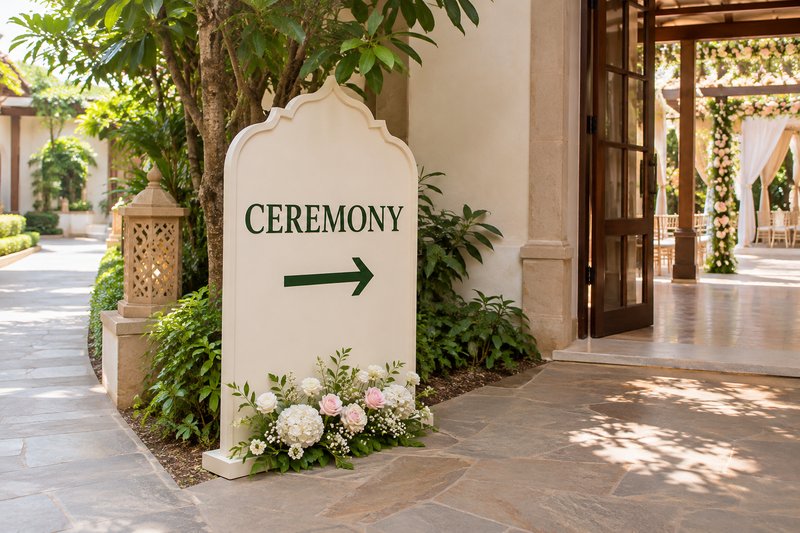
Walk the route before designing the boards
Start at the actual arrival point, whether that is the reception entrance, parking area or shuttle drop-off. Walk each guest route with the venue and hospitality teams.
Mark the places where someone must make a choice: a corridor junction, a change of level, an exit towards a lawn or the entrance to a separate building. Put directions before that decision, then provide a reassuring destination label when guests arrive.
Walk the return route too. A path that seems obvious in daylight may be harder to recognise after an evening function.
Check any proposed step-free route separately. Confirm its suitability with the venue and the guests who need it before adding accessibility symbols. Keep temporary boards, stands and decorations clear of routes and existing safety signs.
Give every location one consistent name
Agree a short list of location names before anyone prepares artwork. Use the same wording on schedules, directional boards, room notes and hospitality-team instructions.
If the hotel calls a space "Garden Terrace", avoid calling it "Sunset Deck" on one board and "Upper Lawn" on another. A themed event name can sit alongside the real location: "Mehendi | Garden Terrace".
The same discipline matters for transport. "Shuttle pickup" should identify a precise place, such as "Main Lobby Entrance", rather than asking guests to interpret "outside the hotel".
Where a property already has clear permanent signs, work with those names. Your wedding signage should help guests connect the celebration to the building around them.
Make the useful information easy to read
Give the destination and directional arrow the strongest visual emphasis. Keep decorative flourishes away from the words guests need quickly.
Use familiar letterforms, clear spacing and strong contrast between text and background. Reserve intricate calligraphy for names or decorative headings. Pale lettering over a patterned background can become difficult to distinguish, particularly when the light changes.
The U.S. Access Board's signage guide explains the importance of conventional letterforms, contrasting colours and non-glare finishes. These are useful design references, not an Indian legal specification for wedding signs.
Choose lettering size according to the actual reading distance. A board across a lobby needs a different treatment from a card beside a hospitality desk. Ask the venue team to consider relevant Indian accessibility guidance, including the Harmonised Guidelines for Universal Accessibility, when reviewing the wider guest route.
Proofread both languages in the finished artwork
Choose languages around your guest list. Hindi and English may suit some weddings; other families will need a different combination.
Have a fluent reader check each version for meaning, spelling and natural phrasing. Then proofread the final print file again. Correct text can become difficult to read if the selected font mishandles a script or the layout creates awkward line breaks.
Keep both language versions tied to the same arrow and destination. Neither should become tiny to preserve a decorative layout.
Include venue names, dates, function times and pickup-point labels in the check. Confirm that the hotel and hospitality team recognise the final wording.
Keep essential directions available without a phone
A QR code can offer a detailed itinerary or map, but guests should not need to scan one to find the next function, washrooms or return shuttle.
Print essential directions where they are needed. If a digital link is included, explain what it opens and test it on more than one phone.
Provide another way to get help. A clearly identified hospitality desk and briefed staff complement the signs, especially for guests who cannot comfortably read the boards. Ask about individual communication needs rather than assuming one format works for everyone.
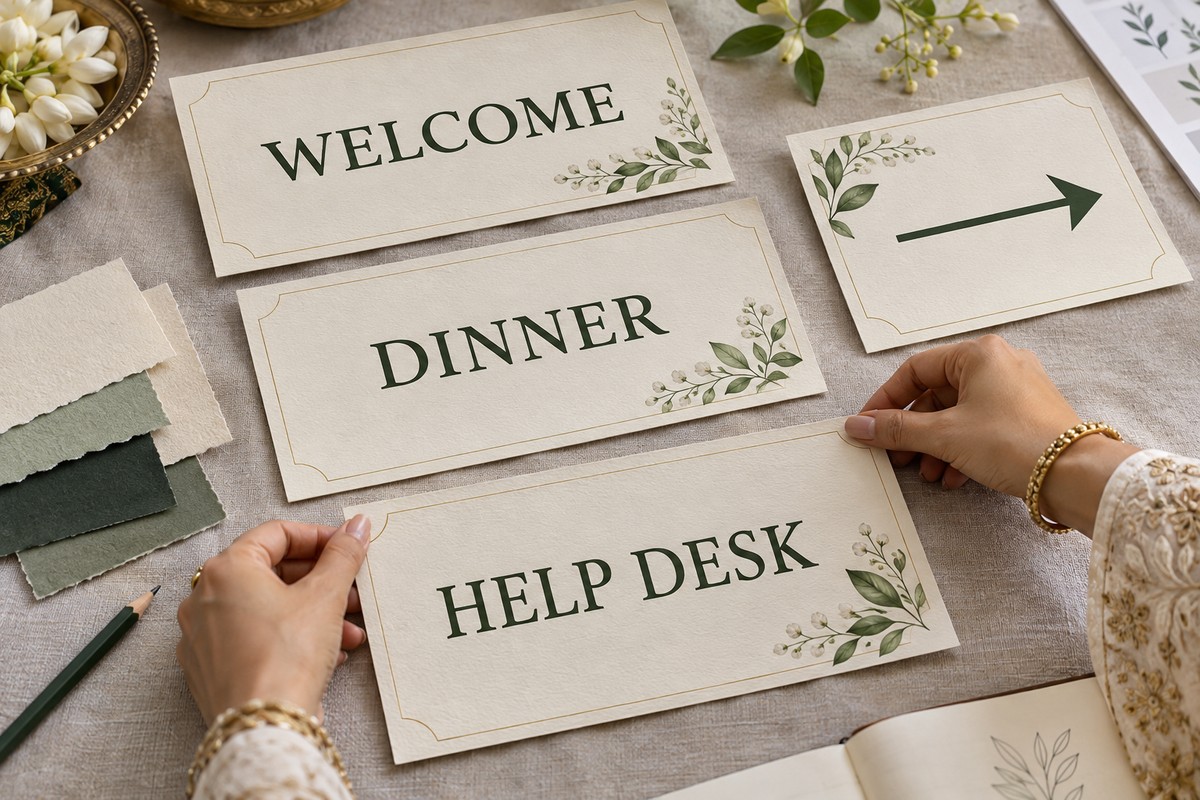
Approve a physical, full-size proof
A design that looks clear on a laptop may behave differently when printed on reflective material or placed against greenery.
Produce a full-size proof of a representative directional sign using the intended material and finish. View it from the planned distance, at its intended height, in daylight and under the event lighting.
Check glare, shadows, arrow clarity and whether flowers or standing guests could obscure the message. Review the stand as well as the print: it should remain stable without projecting into the walking route.
Photographs help document the test, but someone should read the physical board in position before the print run is approved.
Create a signage inventory with named owners
Treat signage as part of event operations. Keep one shared inventory containing:
- Sign ID, exact wording and quantity.
- Installation location, with a marked plan or reference photograph.
- Function and time period when it is needed.
- Artwork version and approval status.
- Person responsible for installation, checks and removal.
- Replacement wording for any agreed location change.
"Near reception" is too vague if there are several entrances. "Inside the main entrance, facing arriving guests" gives the installation team something they can verify.
Record which version is actually installed. A corrected file does little good if an older board remains on an easel. Before each function, have the assigned person check the guest route against the inventory.
Prepare the rain-location update before it is needed
If an outdoor function has an agreed indoor alternative, prepare replacement wording in advance. Confirm who authorises the move and who updates the signs.
Once a change is confirmed, replace directions at every relevant junction. Put a clear update at the original destination too, so guests following an earlier schedule can recover easily. Brief reception, hospitality staff and transport coordinators using the same location name.
Check the revised route for lighting, shelter and any changed access arrangements. Ask the venue and fabricator how outdoor boards will be protected and secured.
At BnB Weddings, customised wedding stationery includes personalised itineraries and signage coordinated with decor and guest hospitality. Bringing those details together helps guests spend less time finding the celebration and more time enjoying it.